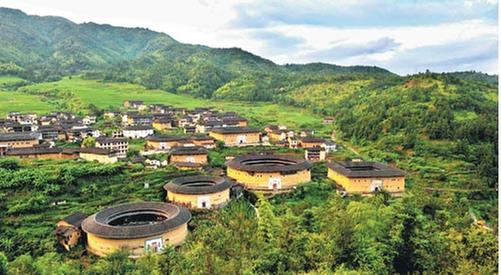
Hakka Earth Building
Introduction
Hakka Earth Buildings, also known as Fujian Tulou, are a traditional form of communal living architecture found in the southeastern region of China, predominantly in Fujian province. These unique structures were recognized as a World Cultural Heritage site by UNESCO in 2008 and stand as a testament to the region's rich cultural history and the architectural ingenuity of the Hakka people.
Historical Background
The Hakka Earth Buildings have a significant historical background, rooted in the migration patterns of the Hakka people. Originally, the Hakka were a subgroup of the Han Chinese who migrated from the northern parts of China to the southern regions, specifically Fujian and Guangdong provinces, during various upheavals in Chinese history. Seeking safety and communal living, they constructed these fortified structures to protect against bandits and local warfare.
Architectural Features
A hallmark of Hakka Earth Buildings is their massive circular or square configuration. These structures are made primarily from compacted earth, which provides excellent thermal insulation and resilience against the elements. The walls, which can be as thick as six feet, offer formidable protection, a feature that was particularly important in past centuries when bandit raids were a constant threat. The circular shape is not only an architectural choice but also a symbolic one, representing unity and collective strength among the families that reside within.
Each Tulou typically consists of three to five stories, housing multiple families from a single clan. The ground floor is often used for kitchens and livestock, while the upper floors serve as living quarters. The layout is designed to maximize communal living, with living spaces arranged around a central courtyard, fostering interaction among residents. Central 'ancestral halls' or temples are an integral part of the design, serving as spaces for ceremonies and gatherings.
The construction of a Tulou is a communal effort, requiring the collective labor of the entire clan. Traditional methods are used, such as pounding the earth to create the walls, a process that ensures durability and strength. The roofs are typically covered with tiles, with eaves that extend to protect the walls from rain.
The architectural design of Hakka Earth Buildings reflects a deep connection to the environment and cultural traditions of the Hakka people. Their construction methodologies and communal living spaces epitomize a sustainable lifestyle, in harmony with nature and community needs. As such, these buildings are not only homes but also cultural monuments that embody the harmony between human habitation and the natural world.
Cultural Significance
Hakka Earth Buildings are emblematic of the rich cultural tapestry of the Hakka people and hold profound cultural significance. These unique architectural structures are more than just residential buildings; they are manifestations of the Hakka people's social organization, community living, and cultural identity. Originating in Fujian province, these massive circular or square structures served as collective homes for multiple generations of Hakka families. They symbolize the communal lifestyle and self-sufficient nature of the Hakka people, who built these structures to withstand threats and natural disasters.
The cultural significance of Hakka Earth Buildings extends to their role as a physical and symbolic representation of Hakka culture. They stand as a testament to the resilience and ingenuity of the Hakka people, who migrated from Northern China to the southern provinces during times of upheaval. The Hakka Tulou have deep roots in the traditions and customs of the Hakka community, reflecting their values of unity, defense, and harmony with nature. The buildings are designed to support communal living, with shared spaces for social interaction, cultural practices, and family gatherings.
Moreover, these earth buildings are pivotal in promoting cultural tourism and cross-cultural exchanges. Listed as UNESCO World Heritage Sites, they attract visitors from around the world, fostering appreciation for the unique cultural heritage of the Hakka people. The preservation and promotion of these structures have encouraged educational initiatives and cultural exchange programs that highlight the architectural, historical, and social aspects of Hakka culture.
In addition to their architectural grandeur, Hakka Earth Buildings have inspired various cultural expressions, including music, art, and literature. The symphony "The Echoes of Hakka Earth Building" by Zheng Xiaoying, for instance, illustrates how these structures have captured the imagination of artists and musicians, further cementing their place in cultural narratives. The symphony and other artistic endeavors serve to communicate the cultural values and history of the Hakka people, making these earth buildings not only a site of cultural heritage but also a living source of cultural inspiration.
Recognition and Preservation
The global recognition of Hakka Earth Buildings as a UNESCO World Cultural Heritage site has brought attention to their historical and cultural importance. Efforts to preserve these structures involve maintaining their architectural integrity while adapting them for modern use. Preservation projects are supported by both the local government and international organizations, aiming to safeguard these cultural treasures for future generations.








